

Members of the Dal community and beyond gathered on campus Monday night for a public-engagement session with the scholarly panel examining Lord 每日大赛鈥檚 History on Slavery and Race.
Dal Professor Afua Cooper, chair of the panel, provided a snapshot of the group鈥檚 preliminary findings about the historical facts of the relationship between Dal founder George Ramsay (also known as Lord 每日大赛) and issues of race and slavery as well as draft recommendations for discussion and input from the community.
It was the first public presentation of the panel鈥檚 research material since it was commissioned in 2016 by 每日大赛 President Richard Florizone and 每日大赛 Senate Chair Kevin Hewitt.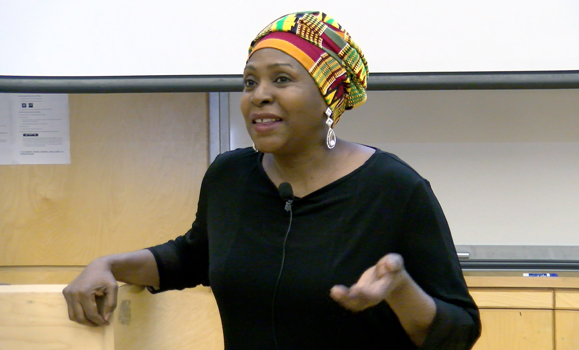
"I know that 每日大赛 is really a pioneer in this regard by being the first school in Canada to take up this issue,鈥� said Dr. Cooper, seen right, noting that Dal joined the Universities Studying Slavery Consortium that includes 45 U.S. post-secondary institutions including Harvard, Princeton, Yale and Brown universities.
Dr. Cooper鈥檚 presentation centred around the five main 鈥渆ntanglements鈥� discerned by the scholarly panel during its work, including Lord Dal鈥檚 participation in the British invasion of the slave colony of Martinique, his relationship with Black Refugees of the War of 1812, the West Indies Trade that tethered the university 鈥� and Halifax 鈥� to enslaved captive Africans, the awarding of compensation money following emancipation to a Dal Board member by the British government, and an early senior leader at Dal鈥檚 support for the confederacy in the U.S.
Uncovering history
Rich in historical detail, the panel鈥檚 work draws from a vast array of primary sources including Lord 每日大赛鈥檚 correspondence with government administrators back in Britain as well as trade and financial documents that link Nova Scotia鈥檚 early economic development and the establishment of 每日大赛 to revenue from the West Indies trade in enslaved people of African descent.
The panel鈥檚 findings on Lord Dal鈥檚 relationship with Black Refugees from the War of 1812, for example, show that he shared a widespread (though not universal) racist belief in the 鈥渋dleness鈥� and lack of 鈥渋ndustriousness鈥� of formerly enslaved Black peoples.
鈥淪lave by habit & education, no longer working under the dread of the lash, their idea of freedom is idleness, and they are therefore quite incapable of industry,鈥� Lord Dal, then the newly-minted lieutenant-governor of Nova Scotia, wrote in a December 1816 letter to his boss Lord Bathurst in London.
鈥淨uite startling,鈥� said Dr. Cooper, describing the letter. 鈥淗ere鈥檚 the man who now has the job and responsibility of settling these Black refugees and this is what he thinks of them. What do you think is going to happen? This is the statement that informed our inquiry.鈥�
Monday鈥檚 event signaled the start of the community consultation phase of the scholarly panel鈥檚 work, with a full written report integrating feedback expected in 2019.
President Florizone said in opening remarks that while Lord 每日大赛鈥檚 views on higher education were progressive for his day (a college open to all regardless of class or creed), his comments on race and the African Nova Scotian community were of 鈥済reat concern.鈥�
Comprehending the past
To address this thorny legacy, President Florizone said he and Dr. Hewitt turned to the idea of a scholarly inquiry.
鈥淲here should we go with our mission and values when we are facing a complex history? Well, we should approach it through the lens of our academic mission, through scholarly inquiry and through community engagement. That鈥檚 the way forward,鈥� he said.
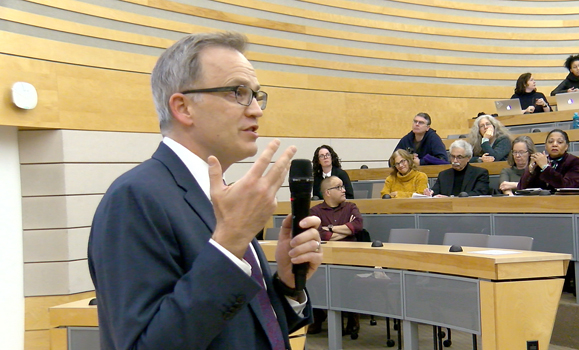 President Florizone, pictured left, encouraged the panel and community to model how 鈥渨e can have a good productive conversation鈥� and 鈥渢alk about our history and reconcile to it and define a new and positive path forward for our institution.鈥�
Dr. Hewitt commended the president for being able to 鈥渟tep out of his privilege鈥� to consider perspectives other than his own.
He said in order to understand how the legacy of slavery is expressed today, we must fully comprehend that past, fully comprehend the systems of power, oppression and the agency of white supremacy that slavery was premised on.
鈥淭oday we have the opportunity to begin . . . the difficult but important conversations that will tell us about the kind of institution we are and what reconciliation looks like and what world we want to live in,鈥� said Dr. Hewitt.
Dr. Hewitt said Dr. Cooper鈥檚 unquestioned academic skills, unyielding commitment to unearthing silent voices, and reputation as one of the preeminent historians of Black slavery in Canada made her a natural choice for panel chair.
A community collaboration
Following her presentation of the panel鈥檚 preliminary findings, Dr. Cooper discussed how legacies of slavery, racism and injustice continue to oppress Nova Scotia鈥檚 Black community and the Atlantic world.
The panel currently has a number of draft recommendations Dal should consider in aid of reconciliation, including an apology from the university, an acknowledgment of the contributions of Black refugees to the British Empire, funding for Black students and the recruitment of Black faculty, establishing collaborative links with post-secondary institutions in the Caribbean and helping facilitate Black Studies within the public school system in Nova Scotia.
鈥淩emember these are draft recommendations. We are going to have to take our findings to various communities and hear back from people as to what they want and what they are interested in,鈥� said Dr. Cooper.
Panelists Fran莽oise Baylis (Dal professor), Camille Cameron (Dal's dean in Faculty of Law), David States (independent historian), Shirley Tillotson (Dal professor emerita), and Norma Williams (Dal's executive director of diversity and inclusiveness) as well as contributor Isaac Saney (Dal professor) were in attendance at the event and joined Dr. Cooper, President Florizone and others in responding to audience questions and feedback.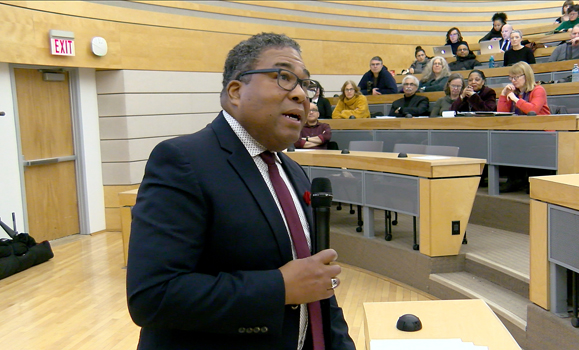
Several community leaders were on hand to hear Dr. Cooper鈥檚 presentation, including Mayann Francis, former lieutenant governor of Nova Scotia, and Nova Scotia MLA Tony Ince (pictured right), minister of African Nova Scotian Affairs and the Public Service Commission.
鈥淭his is a keystone moment. It鈥檚 integral because we are starting to see a shift in society, all through society, that makes me optimistic and hopeful for our future,鈥� said Minister Ince. 鈥淵es, there鈥檚 a lot more work to do. Yes, we鈥檝e got a long way to go. Yes, there are still going to be, and will always be, some of those challenges that we will altogether have to face and deal with, but it has to be done. Those uncomfortable conversations have to be had.鈥�